Guide 4
Reading a price
What the range and confidence mean, and why some items show no price.
The same pricing display appears on your stash card, an item's own page, a public item page, and the public price check result. This guide covers what it shows and why, in both places it uses different words for the same idea.
The range and its confidence
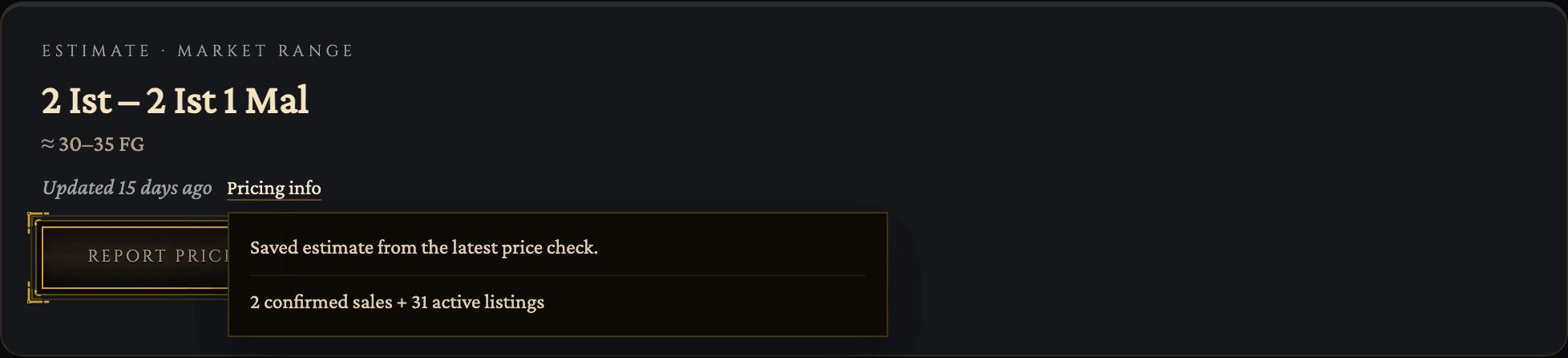
When there is enough evidence, the headline is a number: an FG range, or for many items a rune combination with a plain forum-gold line underneath it. That headline looks the same everywhere it appears: your stash card, an item's own page, a public item page, and the public price check.
When the evidence behind a range is thin, the headline changes to a short plain-language note instead of a number: a note that only a handful of sales back the estimate, a note that the market has gone quiet and the estimate has not refreshed recently, or a note that it is built only from what sellers are asking rather than what anyone actually paid.
Two vocabularies, same range
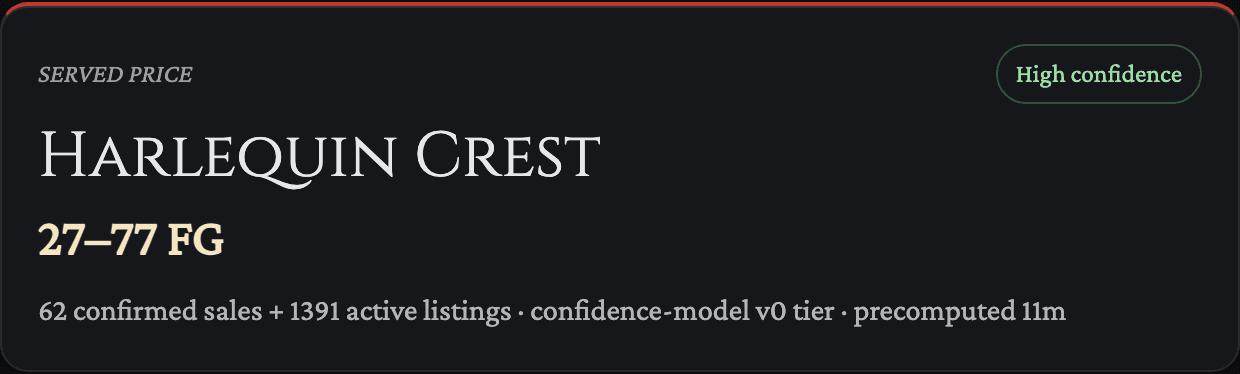
The public price check, reachable without an account, labels its own confidence with a separate, simpler set of words: "High confidence," "Confident estimate," "Ballpark," or "No data yet." A signed-in page never shows those particular words; per the note above, it shows a number, or a plain-language note in its place. Neither vocabulary is wrong; they describe the same evidence for two different audiences.
Where the evidence count lives
Every priced range is backed by a plain count, like a number of confirmed sales plus a number of active listings. On the public price check, that line is always visible under the range. On your own item page or a public item page, it is tucked inside a collapsed "Pricing info" section: click it to expand. Your stash card never shows this line at all: for that detail, open the item.
When there is no price yet
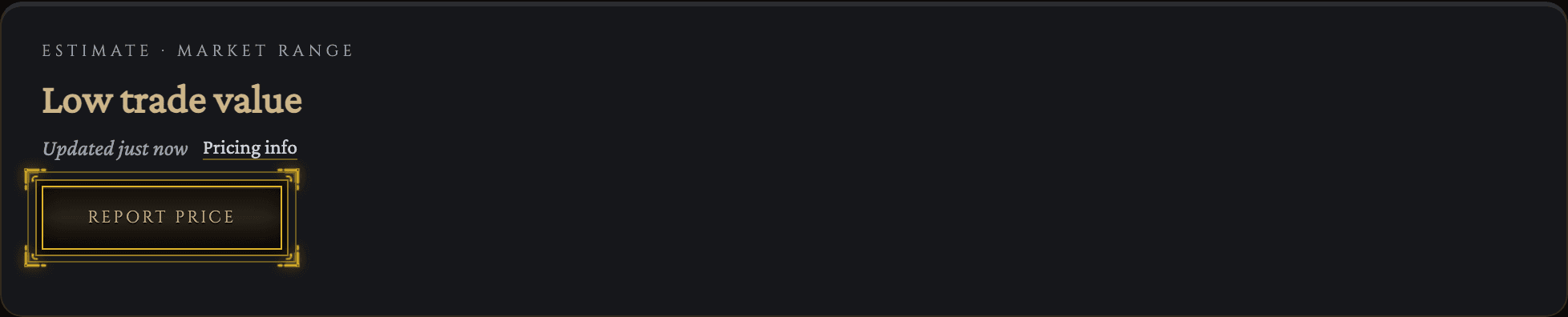
A stash card with nothing priced yet shows "Price on request" instead of a range; it just means no estimate is stored for that item, not that something is wrong. A custom or unrecognized item you added by hand does not always land on an empty state either: it is often still priced, just with a plain low-value note instead of a number, when nothing about it matches anything the market has seen.
Opening the item page can also explain a genuinely empty state in more detail: no comparable sales are stored yet for it, a runeword saved with a specific base does not have comps for that exact base yet, a loose non-runeword base item is not priced as a flat number because its value depends on what runeword, sockets, or ethereal state it ends up with, a Hellfire Torch is missing its class, or the item's saved details need a second look.
Try it with your own loot
Start free and save your first item in about a minute.